Odd parts. A commission, told in objects, No. 3 of 6. A speculative commission.
Token, second cut
Maple, 32 mm, three edges: round, notched, punched. Kept.

The second cut moves the difference off the face and into the edge.
The card token, worth five dollars, is plain and round. The SNAP token, one dollar, has eight notches cut into its rim. The match token, two dollars, has a hole punched through its middle. Three shapes you can tell apart with your eyes shut, which is the point. A vendor sorts a handful by thumb without looking down. A shopper finds the right token in a coat pocket by feel and never has to fan their money out on the counter.
The faces are one design. Same rim, same type, same ring in the middle, which is where the match token’s hole goes. Only the numeral and one word change, and the word is no longer hidden: card, SNAP, match, all the same size and weight.
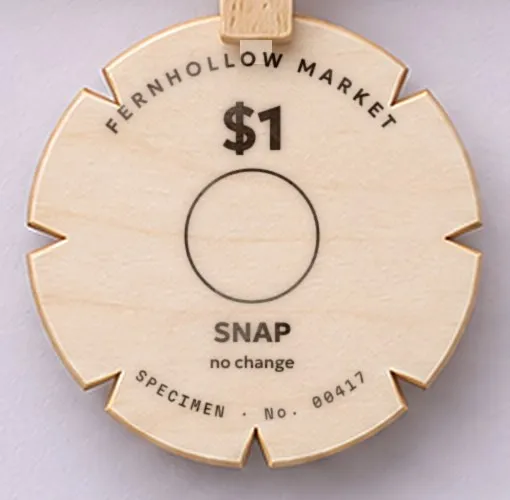
We left the color alone. All three are raw maple, so nothing is coded red or green, and nothing depends on seeing color at all. The notches work for a shopper who can’t see well, and for a vendor reading change in bad light. Under the ring, a word and a short line say what each one buys, because that is all anyone reads at a stall: change given, no change, fruit and veg.
One worry stayed with us. The SNAP token is the only one with notches, so is it still the marked one? In a pocket nobody sees an edge, and on a counter three different shapes read as three kinds of token, not as one odd one.
Every token carries the market’s name, its own serial and the word specimen, because these are drawings, not money.
Lorna took this set to the same two vendors. She reported that one sorted a mixed pile by feel in under a minute, and the other asked whether the notched ones could be made a little deeper for gloves. They can. The cut file now has a deeper notch.
The rest of the serial follows from this one decision. If the difference lives in the edge, everything that touches a token can check it by shape: a slot, a pin, a channel. Nos. 5 and 6 are those things.
A story. Lorna, Fernhollow, the market tests and the results are invented. The objects are drawn, not made. The design thinking is ours, and the SNAP rules are real.