Odd parts. A commission, told in objects, No. 2 of 6. A speculative commission.
Token, first cut
Maple, 32 mm, laser engraved. Cut.

This is the wrong turn, and we are showing it because it was a good idea.
A market that takes SNAP hands out tokens for it. So does the produce match, and so does an ordinary debit card swipe. Three kinds of token, and at most markets they look different: a different color, a different word, a different shape. Lorna’s worry, and ours, was the person paying with SNAP. At a busy stall, a different token is a small public announcement.
So we drew one token for everyone. We fell for the old trade tokens, the ones general stores struck a century ago: double rings, a serif numeral, good for one dollar in trade around the edge. Handsome, a little proud. The only difference between currencies was a line of tiny capitals under the numeral. SNAP, not for change. Nobody at the stall would know who was paying with what.
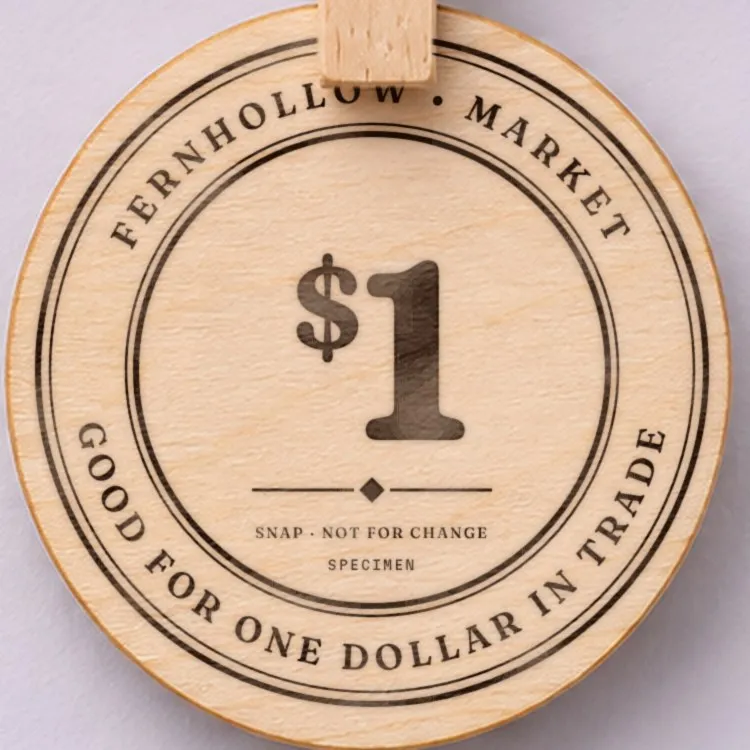
It failed twice, and each failure was enough.
The first was the guidance. USDA expects a market’s SNAP tokens to be told apart from its other tokens, because they come with limits the others don’t: they only buy food that SNAP covers, and a vendor can’t give cash change for them. If the vendor can’t tell, the vendor can’t follow the rules, and the market answers for it.
The second was the stall. Lorna took two samples to the market on a gray Saturday morning. One vendor gave change for a SNAP token, which is exactly what the small print was there to stop. The other read the small print only after Lorna pointed at it, under a tarp, with gloves on. Lettering under a millimeter tall does not survive a 7 a.m. rush.
Hiding the difference hadn’t removed it. It had moved the mistake from the shopper’s hand to the vendor’s, and made the vendor the one who had to look closely at a stranger’s money. That is the opposite of what we meant.
We cut it. What we kept was the question underneath: how do you make three currencies impossible to confuse without making anyone stand out? The answer is in No. 3, and it isn’t on the face at all.
A story. Lorna, Fernhollow, the market tests and the results are invented. The objects are drawn, not made. The design thinking is ours, and the SNAP rules are real.